
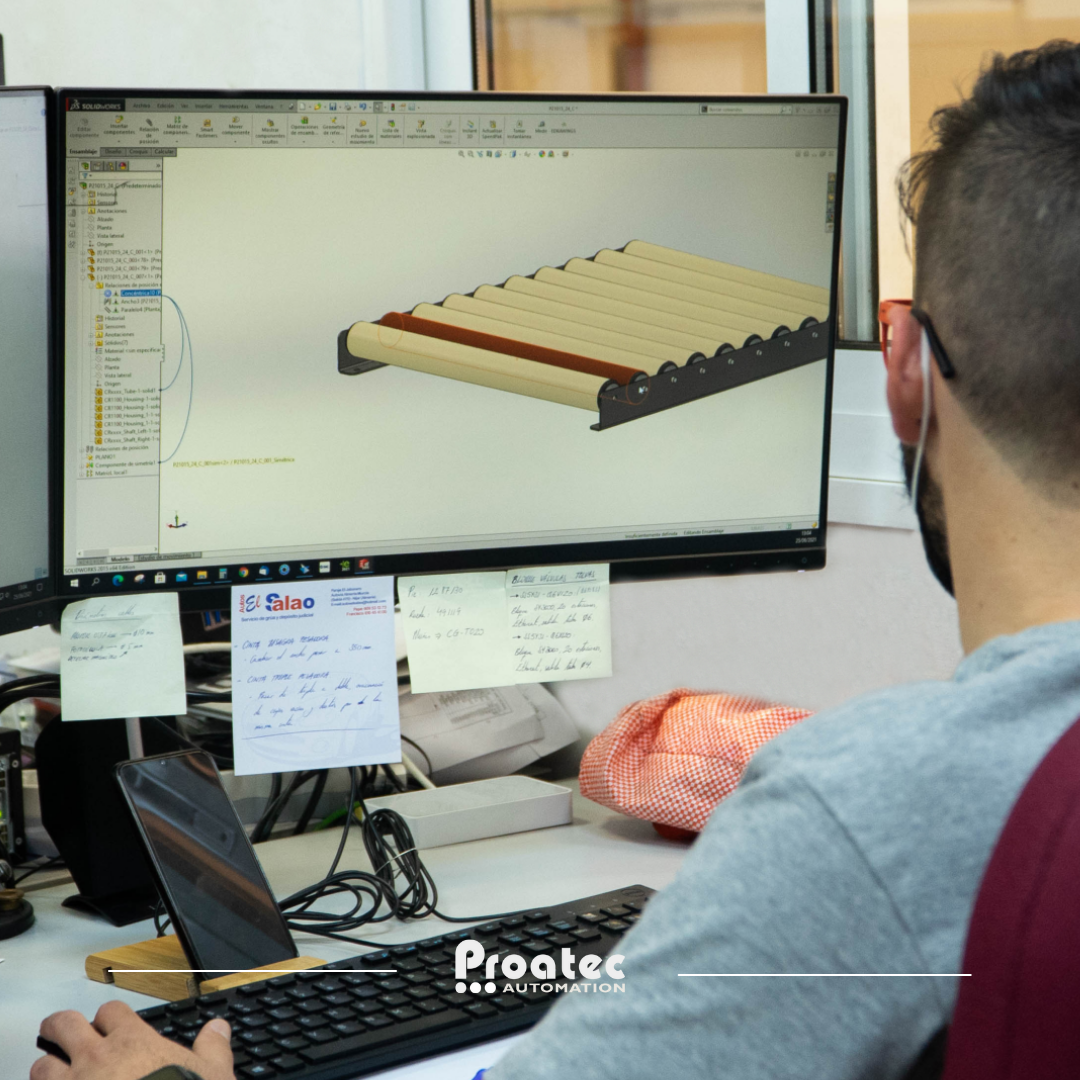
At Proatec Tecnología Industrial, we don’t just manufacture machines—we also design them.
Our technical department has one goal: to design industrial solutions that streamline production processes.
In this post, we want to show you, our loyal reader, the process of designing industrial machinery from our perspective and based on our experience.
For the technical team, it is essential to meet the client’s expectations. We often say that this is where it all begins—including the testing phase.
With our ultimate goal in mind, we strive to design a product that is as sustainable as possible; to that end, we pay special attention to the materials we use.
It is also important to focus on optimizing processes and production costs.
THE PROCESS
PHASE 1: The Client and Functionality in Design
The top priority in this phase is to gather as much information as possible from the client. Agree on a point of consensus between the parties.
Along with this “consensus” comes the team’s creativity in design. Functionality in design is essential at this point.
PHASE 2: Planning the Manufacturing Process
Now that we have the client’s approval and a functional design concept in place, it’s time to move on to planning the process.
As we mentioned earlier, now is the time to optimize the process by controlling costs and materials, among other variables.
The goal is to plan the manufacturing of a product with the highest possible quality at the lowest possible cost.
PHASE 3: Product Prototyping
We generally say that the prototyping strategy is based on the combination of design, development, and engineering.
Well, it is at this stage that we can verify that the design meets the required functions; previously, you proposed them, but now you verify them with near-perfect accuracy.
Over time, changes and variations in the machine’s operation may occur, but these may or may not appear later on.
Once this phase is complete, we can say that we have fulfilled the client’s request.